
244 Wood Street
Lexington, MA 02421
USA
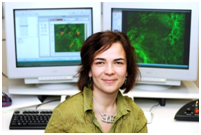 Speaker: Irene Georgakoudi, Tufts University
Abstract: Changes in cellular metabolism play a key role in the normal or diseased development of cells and can serve as important diagnostic biomarkers in a number of areas ranging from cancer to diabetes to regenerative medicine. Traditional assays for metabolic characterization are invasive and can introduce artifacts. In this presentation, I will discuss the use of natural cellular two-photon excited fluorescence as a method to acquire metabolic information in a sensitive and quantitative way, obviating the need to process the sample in any way and offering great potential for clinical translation. I will demonstrate how high-resolution images of three-dimensional tissue specimens can be analyzed to reveal subtle metabolic changes that occur during stem cell differentiation and upon the onset of cancer.
Recommended Reading: Quantitative metabolic imaging using endogenous fluorescence to detect stem cell differentiation.
Quinn KP, Sridharan GV, Hayden RS, Kaplan DL, Lee K, Georgakoudi I., Sci Rep. 2013.
Biography: Irene Georgakoudi studied physics at Dartmouth College, and received her PhD in Biophysics at the University of Rochester. Following postdoctoral work at the MIT Spectroscopy Laboratory and the Wellman Laboratories for Photomedicine at Massachusetts General Hospital, she joined the Department of Biomedical Engineering at Tufts University, where she is currently an Associate professor.
Her work focuses on the development of linear and non-linear spectroscopic imaging approaches that rely on endogenous sources of optical contrast to characterize tissues. She is particularly interested in the use of these techniques for early cancer detection and monitoring of engineered tissue development. She has co-authored nearly 100 peer-reviewed articles and book chapters, has served to organize a number of conferences and as member of the OSA Board of Directors. She is an Associate Editor for PLoSONE. She is the recipient of a Claflin Distinguished Scholar award, an NSF Career award, and an American Cancer Society Research Scholar award.
This meeting begins at 6:30 PM Thursday, October 9th, 2014 and will be located in the cafeteria at MIT Lincoln Laboratory, 244 Wood Street, Lexington, MA 02420. The meeting is free and open to the public. All are welcome. Prior to the seminar there will be social time and networking from 6:30 – 7:00PM in the MIT Lincoln Laboratory cafeteria, the seminar will begin at 7:00PM.
For more information contact David Scherer, Boston IEEE Photonics Society Chapter chair at david.scherer@microsemi.com, or visit the Boston IEEE Photonics Society website at www.bostonphotonics.org.
Directions to Lincoln Laboratory: (from interstate I-95/Route 128)
From Exit 31B
Take Exit 31B onto Routes 4/225 towards Bedford – Stay in right lane
Use Right Turning Lane (0.3 mile from exit) to access Hartwell Ave. at 1st Traffic Light.
Follow Hartwell Ave. to Wood St. (~1.3 miles).
Turn Left on to Wood Street and Drive for 0.3 of a mile.
Turn Right into MIT Lincoln Lab at the Wood Street Gate
Have a valid driver’s license to present to security.
From Exit 30B
Take Exit 30B on to Route 2A – Stay in right lane
Turn Right on to Mass. Ave (~ 0.4 miles – opposite Minuteman Tech.).
Follow Mass. Ave for ~ 0.4 miles.
Turn Left on to Wood Street and Drive for 1.0 mile.
Turn Left into MIT Lincoln Lab at the Wood Street Gate
Have a valid driver’s license to present to security.
All attendees must present a valid driver’s license to MIT Lincoln Laboratory security. To get to the Cafeteria, proceed toward the Main Entrance of Lincoln Laboratory. Before entering the building, proceed down the stairs located to the left of the Main Entrance. Turn right at the bottom of the stairs and enter the building through the Cafeteria entrance. The Cafeteria is located directly ahead.